Brad Shonk
Free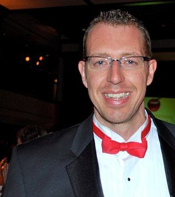
HAPPY: What are your earliest memories of books and reading? Did you have any favorite authors, books or characters? What did you like about them?
SHONK: I remember the book Clifford the Big Red Dog. My mom would read the book to me. As a young child I loved reading anything about sports. I also fondly remember reading choose your own adventure books as I could decide what path the book took next.
HAPPY: Did your childhood experiences with books influence you in your teaching, your parenting or both? If so, how?
SHONK: Yes, if you can teach a student to love reading you have done them and society a huge favor. A love for reading is really a love for learning. My sister is doing an outstanding job making reading a daily routine before they go to bed with my precious niece Adrienne, who will turn two on May 28th.
HAPPY: What about early educators? Were there individuals who had a lasting impact? Would you acknowledge them here?
SHONK: Mrs. Poyser taught me all subjects in 3rd and 4th grade. I can’t tell you one thing she taught me, but I remember how special she made me feel and how much I loved school!
HAPPY: Did your process of becoming a skilled reader inform your own teaching in some way? Could that process have been better or more fun, somehow?
SHONK: I remember being in charge of turning the slide projector and reading the bottom of the screen. I learned to read and remember it being a fun activity and that’s what I want my students to share.
HAPPY: Have there been books, authors or characters that have had a profound effect on you as a person (historically and/or currently)?
SHONK: I simply love reading. Every book has a profound impact on me because at a minimum the book makes me think and I always learn something new. My favorites are biographies and autobiographies because they show how all people go through challenges to become the success they are. Biographies and autobiographies should be must reads for all students at all grade levels. Students need to know stories of other people!
HAPPY: How can educators be effective in a speed-driven, entertainment- and information-saturated culture? What role can books play? What do books offer us that we can’t get from other media?
SHONK: Teachers can be effective by engaging students in activities that are both relevant and engaging for them. Books play a vital role in this process as a means for students to learn new cool stuff. Books offer a time for each individual to read something and interpret what they read in their own way. It is the ultimate individualized instruction. No two people can read the same book and get the same thing out of it.
HAPPY: Are reading aloud and wide reading valuable for today’s learning environment? If so, how do we incorporate this, given all the demands on educators today?
SHONK: Certainly, reading aloud is effective for all students– in particular the students who struggle with reading— it’s effective to hear the story from a fluent reader. You simply make the time to do so as it is the right thing to do.
HAPPY: What kinds of things do you do or are you willing to do to motivate your students? Please share any ideas you’d like to have others consider and/or emulate.
SHONK: I think any educator should and would do anything to have their students learn to love reading. If that includes earning money, dressing up like a character in a book, shaving their head for a specified goal, or any other off the wall idea go for it with gusto.
HAPPY: How can educators promote literacy skills (reading, writing, speaking and listening) across the curriculum and not just in language arts classrooms?
SHONK: Collaborate school wide so everyone is working toward the same goal. Everyone in education wants what is best for students. Teachers working together is a beautiful thing to see!
Brad Shonk is a fourth grade teacher at Gorenflo Elementary School in Biloxi, Mississippi. He was the 2010 Teacher of the Year for the state of Mississippi.